Publishing 17 August 2026 · Lumenara Press

Why have you spent a lifetime
achieving — and still felt like
something was missing?

UbU

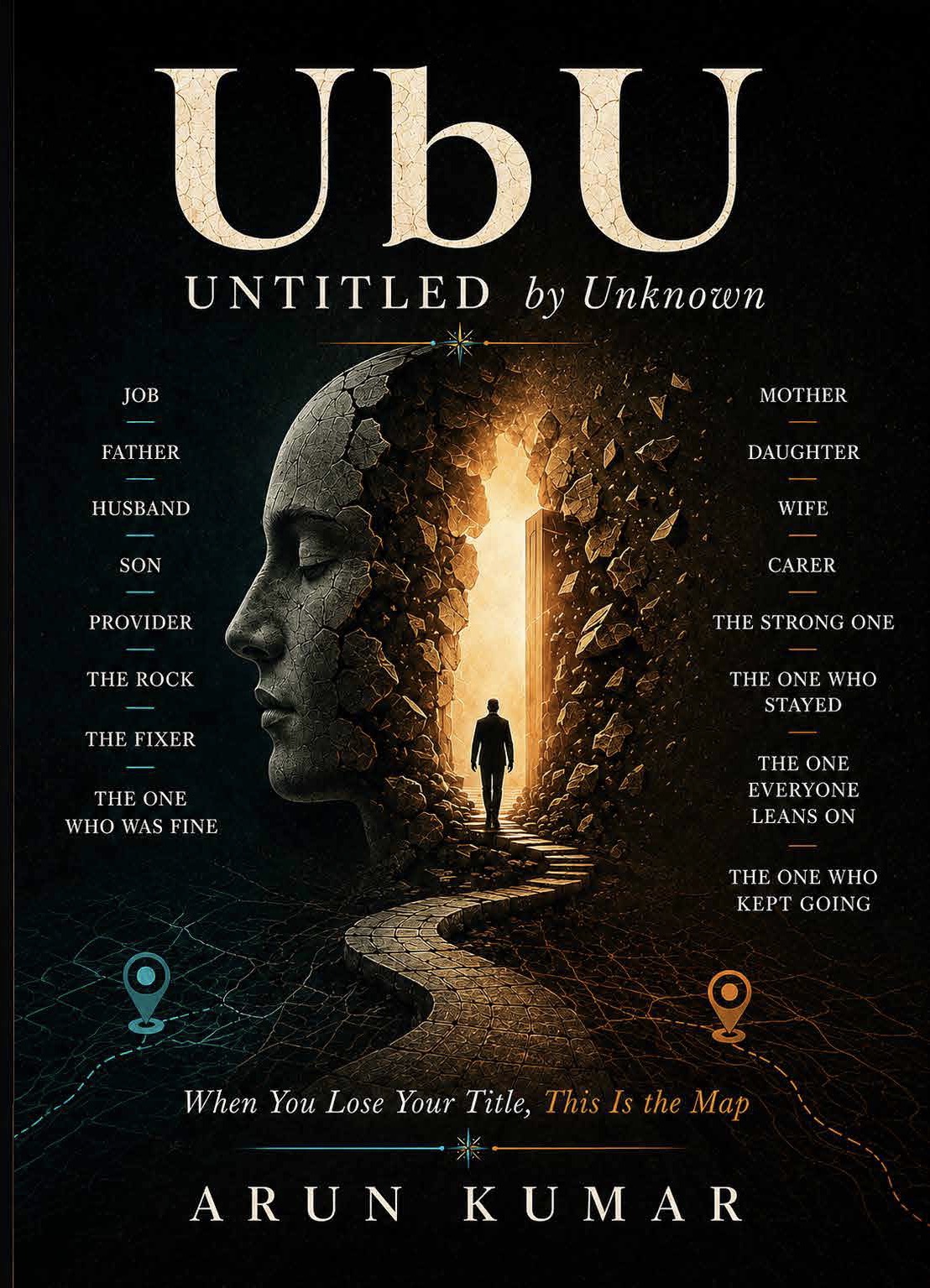
UNTITLED by Unknown · Arun Kumar

TAT TVAM ASI

↓   scroll
UbU — UNTITLED by Unknown by Arun Kumar
UbU
UNTITLED by Unknown
"When you lose your title,
this is the map."
Arun Kumar · Lumenara Press · 17 August 2026
What readers say

The book
found them first.

I stopped a thought this morning that would have made me doubt myself. I'm still learning to catch them in a real threat state — but I'm catching them.

I finished it. I'm reading it again on the plane. There are things I need to sit with more than once.

Self-respect before self-love. That order is interesting. Being seen by yourself first — we forget that. We're conditioned to look outward. How cruel is that.

I was nervous before my exam. Breathing didn't work. Then I tried the Observer — I said "you're trying to protect me" — and I instantly calmed down. I passed.

This isn't about me — but it made me reflect, recognise, and reconcile my own thoughts.

One of the most accurate articulations of love locking each other out that I have read.

The break is the door
"The break is the door.
Everything behind it was already waiting."
Introduction
The Book

The thing built to
protect you — wearing you out.

There is a pattern that runs through every life. The build-up. The fall. The question. The change.

The challenge is that when you see the fall as failure — you miss the point entirely. It is a journey inwards. Every tradition that has examined the human condition — Vedic philosophy, Jungian psychology, modern neuroscience — points to the same place.

This book is one person's walk through that territory. Written from the inside, in the order it happened, by someone who didn't know where it was going.

Why does success still feel incomplete?
Have you ever really understood how your mind works?
Who are you — without the job title?
Maybe you have been your own worst enemy, without knowing it.
What if mastering your mind made you more powerful, not less?

"Not every thought in your head is actually you.

The fact that you did not act on that thought is the proof that the thought was not the whole of you. Something in you was already watching it. Already choosing. Already free."

Chapter One · The Changing Room

"I found out who was watching.
I learned his name.

I know where the ground is.
It was always here."

Chapter Twenty-Two · UbU
Five thousand years. One map.
"Five thousand years of observation.
One hundred years of brain science. The same map."
The Three Lenses
Observer Flow Framework

A reflex you train.
Not a process you run.

Not a management tool. An anchor that emerged from the questions — built to help you understand why, and return to who you actually are.

01
Observe
Catch the feeling before it becomes a reaction. The pause between stimulus and response. The door everything else walks through.
Vedic: sākṣī · witness · Neuroscience: metacognition
02
Name it
Which shadow is running? Name it once, clearly — then be quiet. Naming reduces amygdala activation. This is measurable.
Vedic: buddhi · Neuroscience: prefrontal cortex
03
Thank it
Acknowledge what it was trying to do. Not gratitude as performance — gratitude as completion. The emotional arc closes. The charge discharges.
The step that closes the arc — not toxic positivity
04
Return
Back to the self. Not back to the noise. The sankalpa as compass — the ground you return to, not a destination.
Vedic: sankalpa · soul intention
Why the emotional arc matters
Suppression interrupts the arc.
Gratitude closes it.
Every feeling has an arc — arrival, peak, completion, release. Interrupting it keeps the charge in the body. Step three completes what the feeling was already on its way to doing. The Vedic tradition, somatic therapy, and trauma-informed neuroscience all describe this — from different centuries — as the same mechanism.
"Anger is a feeling, Daddy. It's not you."
Age 3 · The proof of concept
THE SELF OBSERVE catch it 1 NAME IT 2 THANK IT 3 RETURN to the self 4 NOT A PROCESS. A REFLEX.

Full appendix map in the book

The same framework that helps you step outside a thought at 3am works in a surgeon's consulting room. It works in a board presentation. It works in a distributor negotiation under pressure.
Because it addresses the human operating system — not the situation. The Observer Flow Framework is used in clinical MedTech adoption conversations to read what a stakeholder is protecting before responding. It is used by commercial directors managing pressure before high-stakes decisions. The framework works wherever a human being is reacting rather than choosing — which is most of what leadership and commercial performance actually is.
Observer Flow in commercial practice → Lumenara
The pause was the door
"The pause was not the answer.
It was the door."
Chapter One · The Changing Room
Key Concepts

The vocabulary
of the map.

Vedic Sanskrit and contemporary neuroscience — arrived at independently, describing the same territory for thousands of years.

Vedic · Sanskrit
Manas
= Default Mode Network
The narrator
The reactive mind. The voice that runs commentary without permission. Not to be fought — just seen.
Vedic · Sanskrit
Buddhi
= Prefrontal Cortex
Quiet authority
The intelligent mind. Speaks once, clearly — then is quiet. Can override the alarm if given space.
Vedic · Sanskrit
Ahamkara
= The I-Maker
Identity construction
The identity builder. When the function stops — the job, the title — it panics. Not the same as the self it was protecting.
Neuroscience
Amygdala
= The alarm
Fires before thought
Fires to both real threats and the stories the manas generates. Cannot distinguish between the two.
Vedic · Sanskrit
Samskāra
= Somatic groove
Body memory
The body's memory before language. The shoulders that don't know the kitchen is forty years ago. The grooves can be recarved.
Vedic · Sanskrit
Sankalpa
= Soul intention
The compass
Not a goal — a direction. Who you are when the performing stops. The ground you return to.

"The pattern has been repeated across millennia because it describes something true."

Introduction · UNTITLED by Unknown
The Warrior · Short Film

The Warrior.
A short film.

"The mask works.
Until it doesn't."

Four sequences. One man. The armour he built to survive — and the moment it falls away.

The Wardrobe The Kitchen The Boardroom The Collapse The Keyboard
The garden
"It was just a Wednesday. A beautiful Wednesday
in the middle of a much longer journey."
Chapter Two · The Garden
About Arun
Arun Kumar

Arun Kumar
Solihull, UK

Arun Kumar

Author · Founder, Lumenara · 17 years in MedTech

I spent twenty years in medical devices building a life that made complete sense on paper. When it stopped making sense — when the title disappeared and the inbox went quiet — I looked for the book that described what that felt like from the inside.

I couldn't find it. So I wrote it.

What emerged was the Observer Flow Framework — assembled from lived experience, then mapped against five thousand years of Vedic psychology and contemporary neuroscience. Three traditions. The same map.

I live in Solihull with my wife and daughters.

Lumenara MedTech strategic advisory — clinical adoption and commercial expertise across UK and European markets. 17 years inside the launches, the stalls, and the recoveries.
Visit Lumenara ↗
Questions

What people
ask most.

For the curious, the sceptical, and the person who just wants to know if this is for them.

A four-step practice — Observe, Name It, Thank It, Return — for stepping outside a thought or feeling rather than being swept away by it. It is not a technique for crises. It is a reflex trained through repetition in ordinary moments. It emerged from lived experience and maps precisely onto both Vedic psychology and contemporary neuroscience.
It is a memoir that produced a framework. The story came first. The framework emerged from examining that story honestly. The entry point is always lived experience — not theory. If you are expecting bullet points and five-step systems, this is not that book. If you want to understand why you operate the way you do, it is.
Every tradition that has examined the human condition describes the same arc: build-up, fall, the question, the change. What we call burnout or midlife crisis is the moment the identity built on function — on achievement, on role, on the approval of others — stops working as the answer. The direction from there is inwards. That is what every religion, philosophy, and now neuroscience points to. This book is a map of that inward journey.
Because the thing driving the achievement was never really about the achievement. It was about something older — a need for approval, for safety, for proof of worth — that no amount of external success can reach. The garden was real and beautiful. But it was never the destination. The exhaustion you feel is not a sign something has gone wrong. It is a signal pointing inward.
No. Step three is the most misunderstood part of the framework. Gratitude here is not about finding a silver lining. Every feeling has an arc — arrival, peak, completion, release. Suppression interrupts the arc and keeps the charge in the body. Acknowledging what the feeling was trying to do allows the arc to complete. The Vedic tradition, somatic therapy, and trauma-informed neuroscience all describe this — from different centuries — as the same mechanism.
No. The book was written before the author understood the Vedic framework. The lived experience came first. The ancient map confirmed it afterwards. The Vedic terms appear because they are precise and useful — not because you need to believe anything. No altar required. No retreat. No prior knowledge.
Yes. The redundancy was the door for the author. But the door can be divorce, illness, loss, burnout, or the slow realisation that the life you built no longer feels like yours. The architecture of identity collapse is universal. And you do not need to have collapsed to benefit — many readers recognise themselves in the performing, the exhaustion, the nagging incompleteness, long before any fall.
That is the question the book is about. Not in an abstract philosophical sense — in the most ordinary, Monday-morning, three-in-the-morning sense. The book does not answer it for you. It gives you the map one person used to find his own answer. The walk is yours.
UNTITLED by Unknown publishes on 17 August 2026 under Lumenara Press (ISBN 978-1-0676890-0-1). It will be available in paperback and ebook through Amazon UK, Waterstones, and direct from this site. Pre-order opens closer to launch — use the button below to be notified.
Publishing 17 August 2026

When you lose your title,
this is the map.

Paperback and ebook. Pre-order opens closer to launch.

Publication date
17 August 2026